https://etruscanpress.org/wp-content/uploads/2023/02/SSG-interview-1.6.pdf
]]>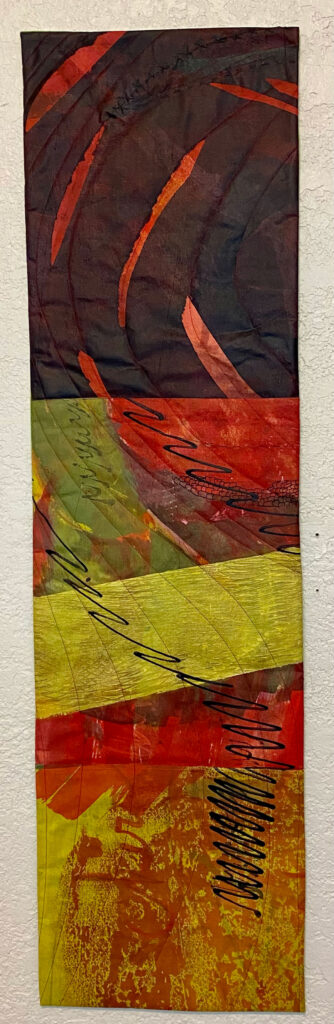
I’m happy with the movement of this piece, and I learned an awful lot about how to work with acrylics, which I both hate and love. I don’t like what it does to the hand of the fabric, making it feel like rubber, but my god it is so easy to work with–no batching, very little prep, etc. And of course, there’s the issue of having white, which you don’t have with dye or thickened dye or earth pigments.
The second week with Claire was more difficult for me, and there were moments of anger and sadness, even tears! This was the week we were supposed to “work with intent,” and I had lots of intent. I won’t go into all the ideas I had, but let’s just say there were too many, and none of them were really working out as I hoped the first couple of days. I remembered what the French poet Mallarme supposedly once said to the painter Degas when he complained that he didn’t understand why he couldn’t write successful poems since he had “so many ideas.” Mallarme reminded him that poems were written with words, not ideas. I realized that my eyes were bigger than my “hand” if you will, and that I simply didn’t yet have the technique I needed to accomplish what was in my head.
After much hand wringing and many failed attempts to bring about my ideas with thickened dye, I picked up a needle nose bottle, filled it with with black thickened dye and began scribbling on fabric. If nothing else, I thought, I’ll master the needle nose. It felt familiar, like a pen or pencil. After experimenting with the thickness of the dye, the pressure and slant of the needle nose, I wondered what would happen if I wrote across pleated fabric. I started folding the fabric in various ways, scribbling across it and opening it up to reveal broken words and phrases that looked, oddly enough, like runes. I tried this in various ways, most of them unsuccessful, but then:
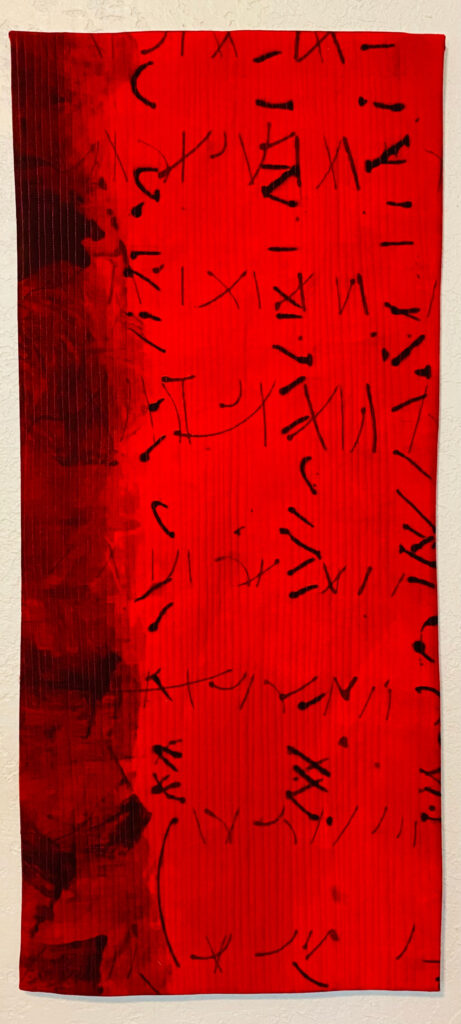
This happened. And then this:
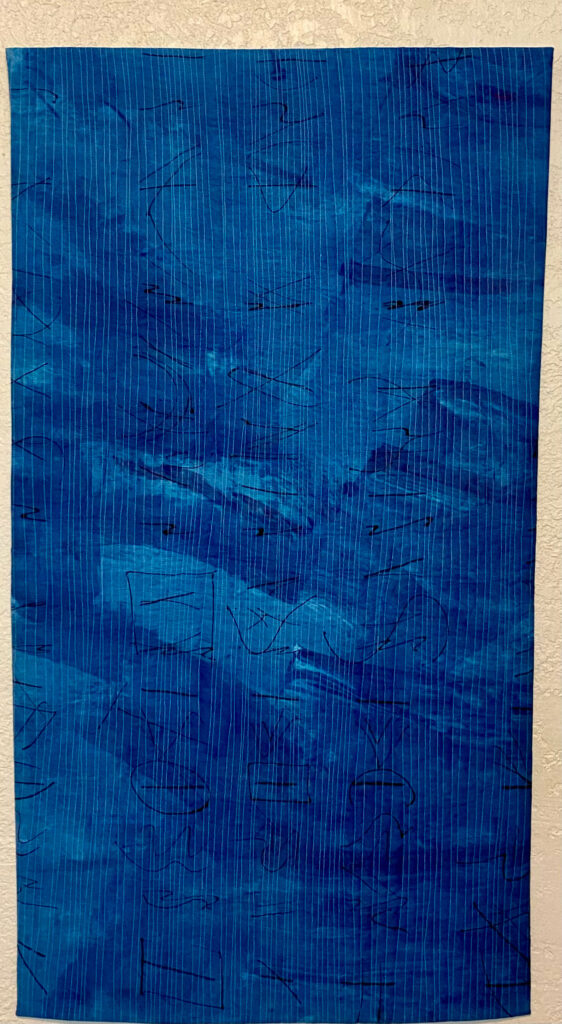
I was happy with these two, and when I did my final presentation to the group I noted that I felt confident I could bring this technique of needle nose work and pleating back to my studio and develop it more fully and perhaps with more complexity. Claire approved and gave me the order to make 100 of these. She had given the same assignment to Nancy Crow when she was learning how to monoprint. According to Claire, Nancy had been complaining she didn’t get this monoprinting and Claire reminded her of how long it had taken her (Nancy) to learn how to cut fabric without a ruler. “Make 100 of them,” Claire said. A few months later, again according to Claire, Nancy called to tell her she had made 100. She subsequently published a book of the best of these. Claire reckons I’ll wind up with 20 that are just ok, 20 that are wonderful, and, well, who knows about the rest.
And I’m happy to have found a technique that includes my love of fragmentation as well as an acknowledgement of my work as a writer.
So here are the first two of a hundred. Stay tuned.
]]>We were asked to pick three images or a piece of writing that resonated with us. We then spent time journaling words and phrases that the image or writing evoked in us. We were provided with a 10 foot by about 3 foot scroll of muslin that had been pre-primed with a 1-1 solution of liquid gel medium and water. We were asked to pick a six-color palette plus black and white.
I started with an image of a banana flower, an angel’s trumpet, and a poem, “Reasons to Live: the Color Red.” I loved the plum colors of the banana flower and the jumble of green leaves beyond it:
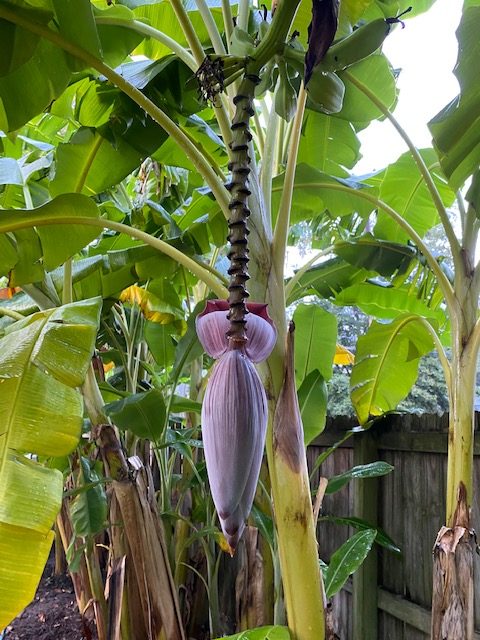
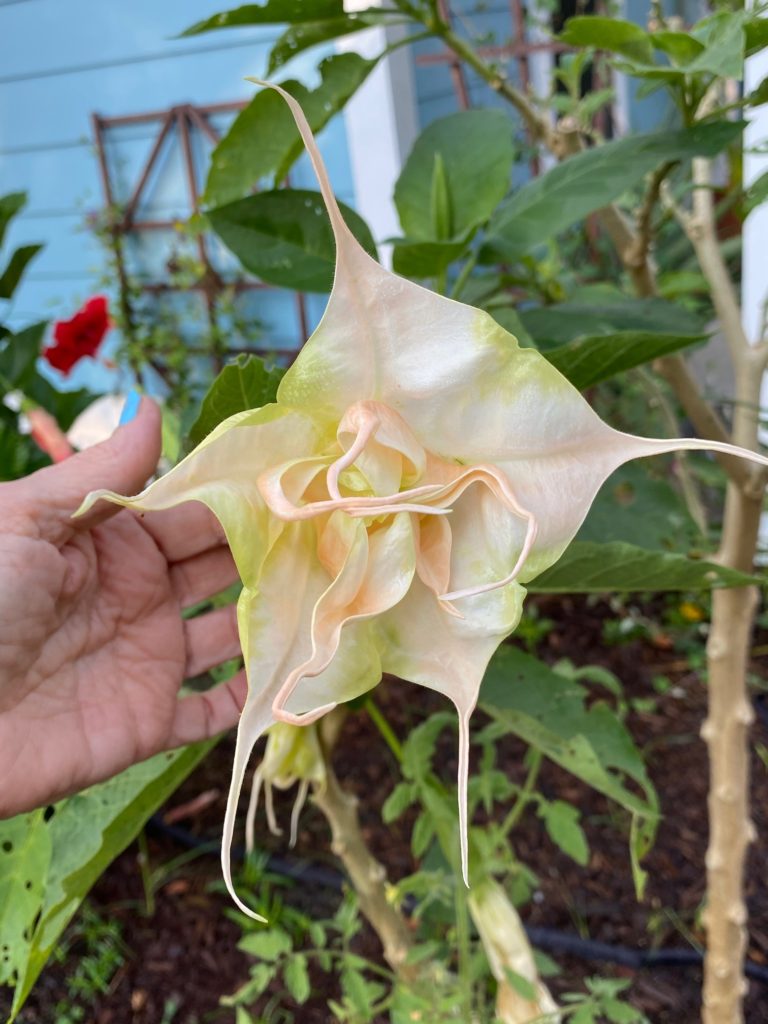
I loved the star-like shape of the Angel’s Trumpet as well as the soft, subtle peach and apricot colors:
And I wanted to find a way to evoke the emotional power of the reds in this poem:
Reasons to Live: The Color Red
cowboy boots, scarlet suede
still in the box, smelling like sex
pomegranates, the seeds plumped open
their dark juice seeping into the butcher block
whole cherries in preserves, full
in your mouth, a thick spoonful,
fat raspberries, autumn apples, the memory
of a rich Cabernet or spicy Shiraz,
sun-warm tomatoes from your garden
thick steaks rare and soft,
their blood speaking tongues in your mouth,
your flannel nightshirt, tartan-frayed and forgiving
the dresses from your youth burning
in the closet like coals from a good fire,
salmon when they are dying,
maple leaves when they are dying,
your favorite color before you knew
any better, first color you sang,
the color you love in your mouth,
color that announced your birth into the world.
After journaling we were asked to write words on the cloth. I used a thick graphite pencil to write mine.
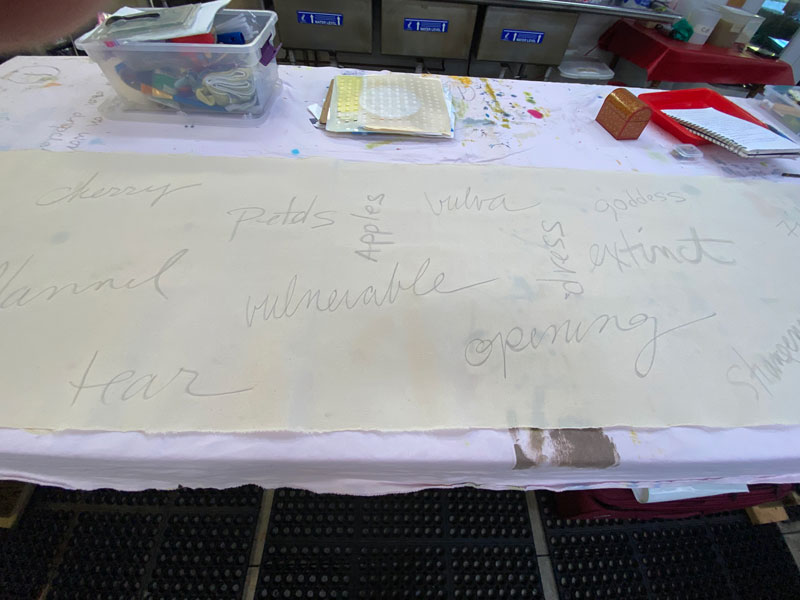
We then drew our images first by memory and then by copying directly from either the image or a photo onto the fabric, again I used graphite. and than outlined them with color. I used a couple different sizes of paint brushes. I didn’t like the way the shape of the banana flower was coming out so I decided to drop it from future considerations. The pale colors of the Angel Trumpet as well as its shape proved difficult for me to handle and I decided to drop that as well and focus on the imagery from the poem.
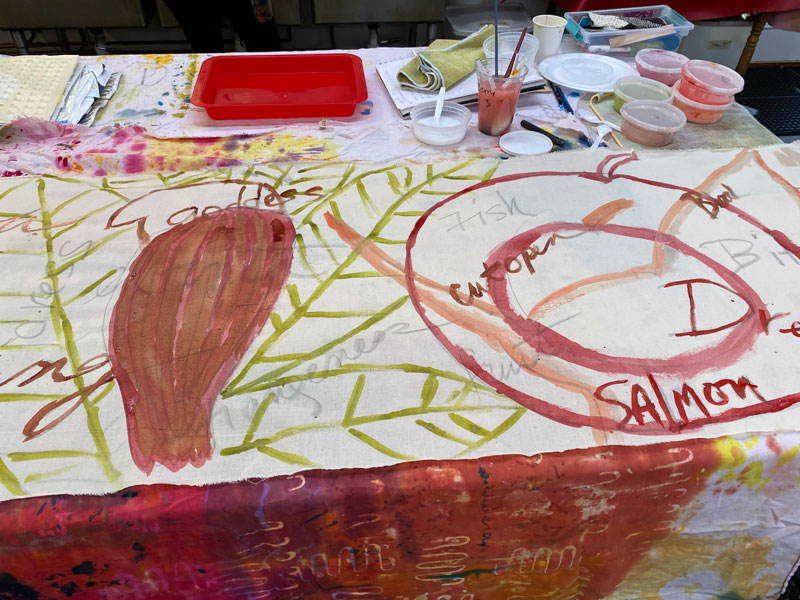
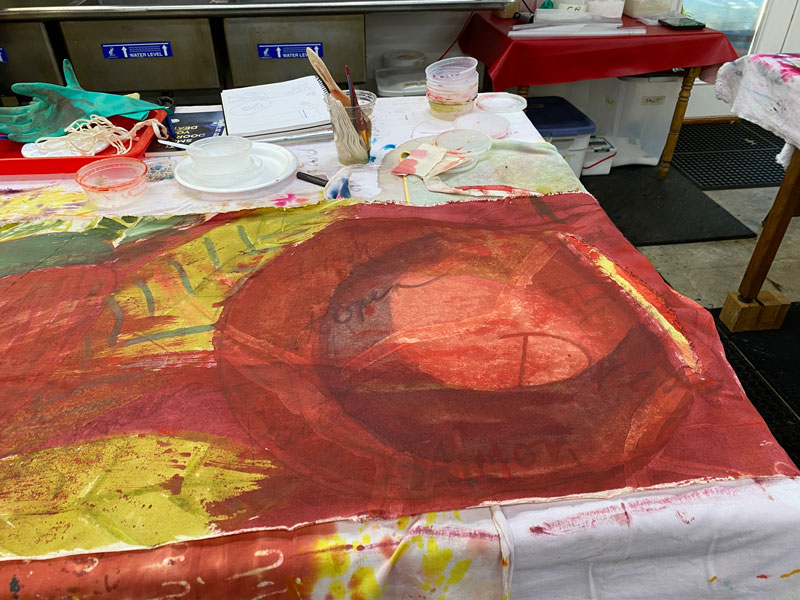
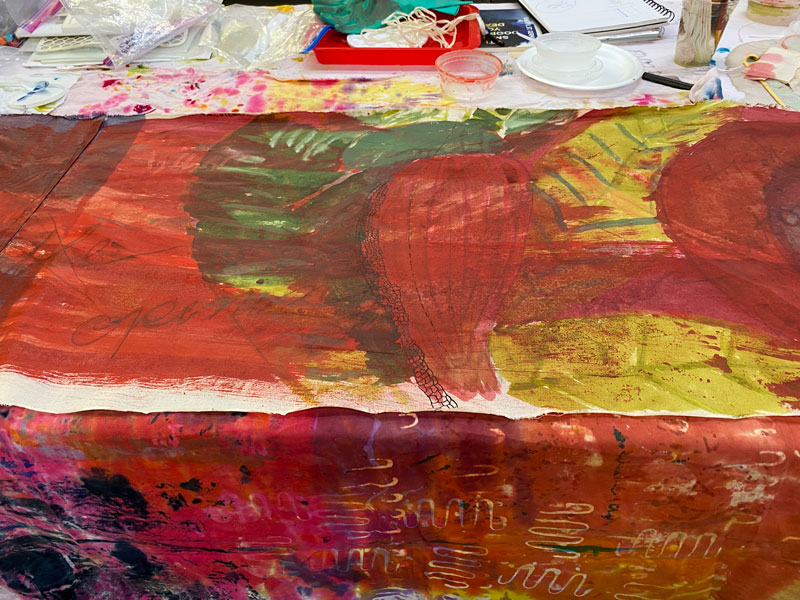
Above you see me playing with shades of red for a fruit-like shape, and chartreuse for what had started out as banana leaves. Below I’ve added some deeper greens that I decide I don’t like and will later get rid of.
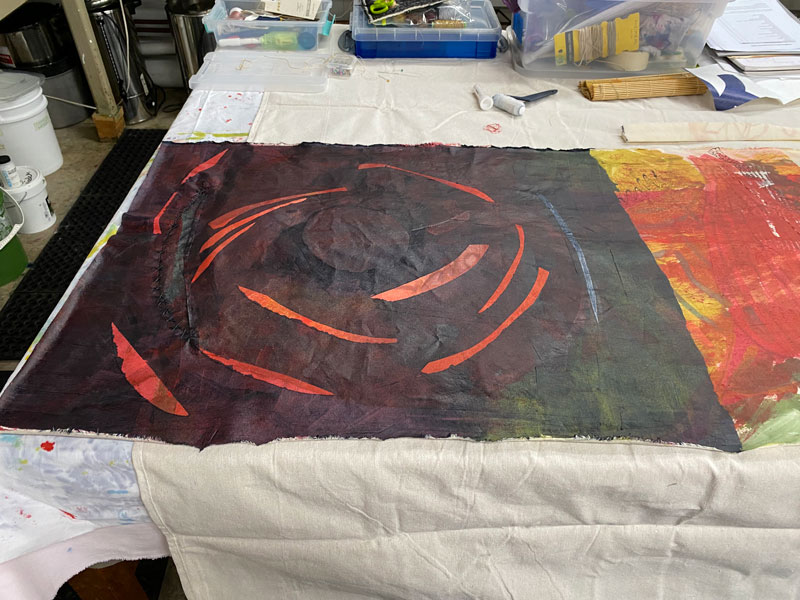
I did quite a lot of manipulations including pleating, cutting and inserting paper, etc. I was beginning to think of this as a whole cloth, sort of totem-pole like, though Claire had warned us no final pieces might come from this series of exercises, that it was about exploration. Here, above, I obliterated much of the red as it felt too overwhelming. Using masking paper resists I left enough of the red to suggest the circle that had been there before.
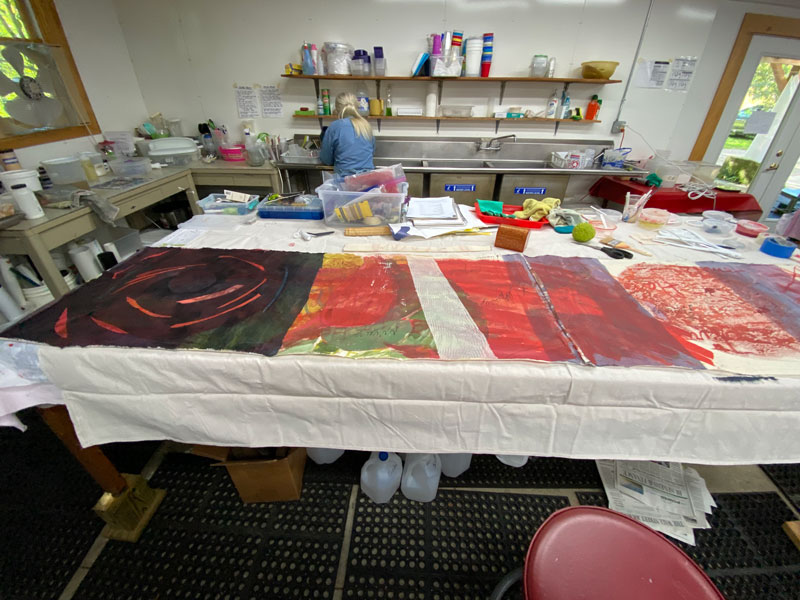
Here, above, you can begin to see what it’s starting to look like. I also obliterated some of the dark green I didn’t like with a Titan Buff heavy body acrylic that I then scratched into to make wavy marks. Later I will paint over this in chatreuse. You can also see the pleat in this photo.
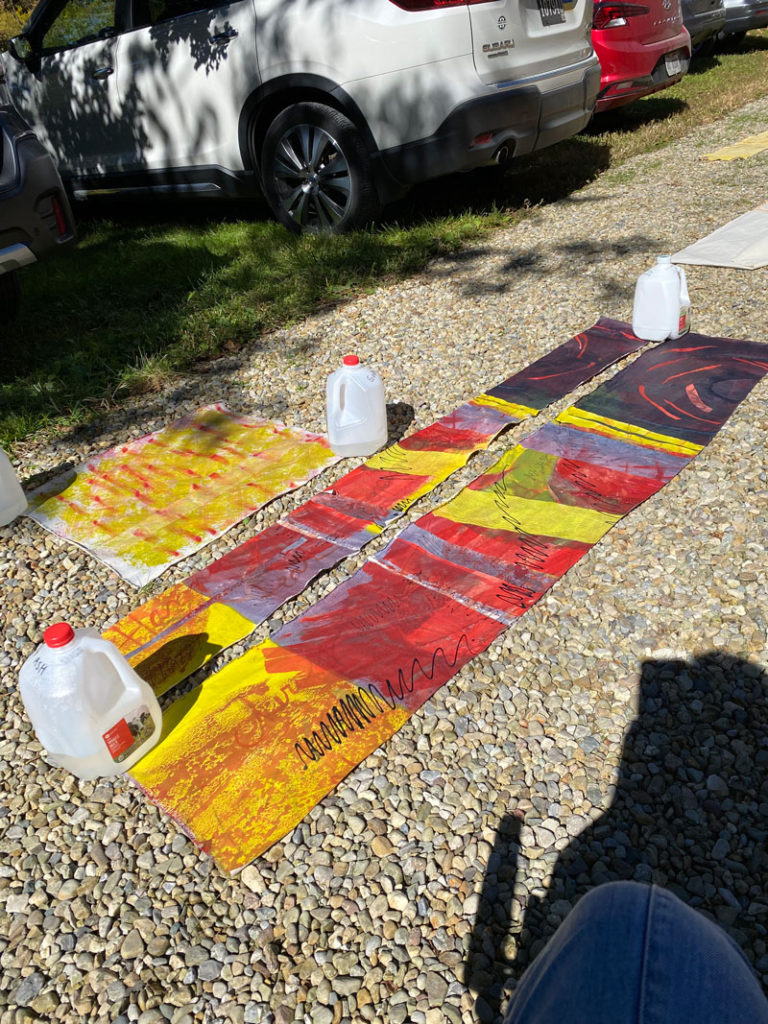
Here, after more manipulation and adding scribbles with a needlenose bottle, doing some monoprinting and beefing up the chartreuse, I decided to cut off a few feet off the bottom–I had been working with trying to evoke plaids from the poem but it wasn’t working out so I decided to cut it off. I also decided to cut the whole thing in half. I wanted to break up the circle up top, which felt too dominating.
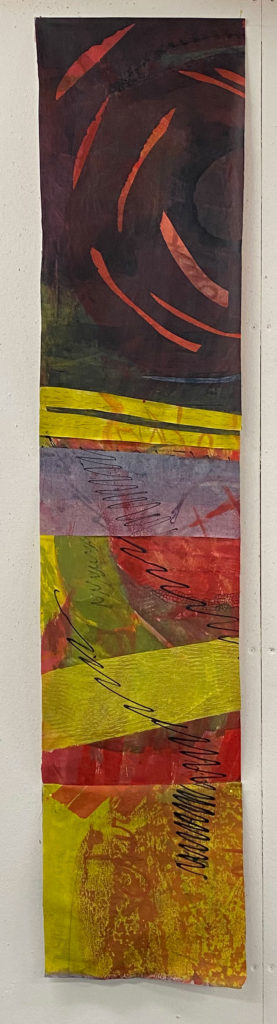
First time I hang it. It feels like there is too much going on, although I like the colors and movement. I decide to edit and cut more out.
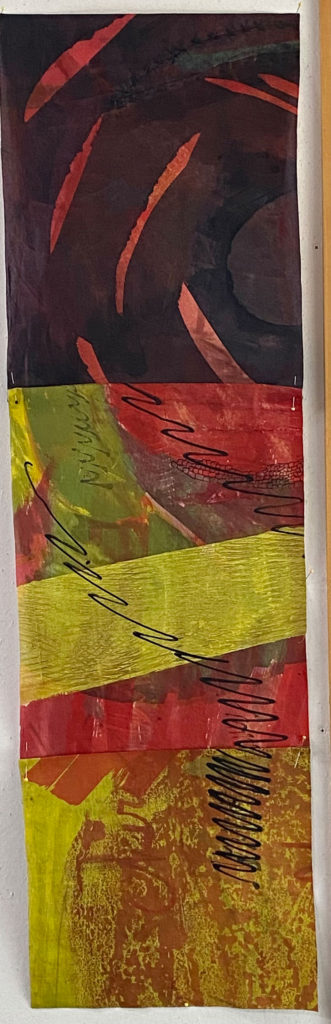
And here’s what may be the final edit. I’ll have to wait til I get home to sew it up and I may make a few more tweaks. I’m happy with pretty much everything in this final edit, although it has moved so far from where I began as to be unrecognizable. What a wondrous process.
]]>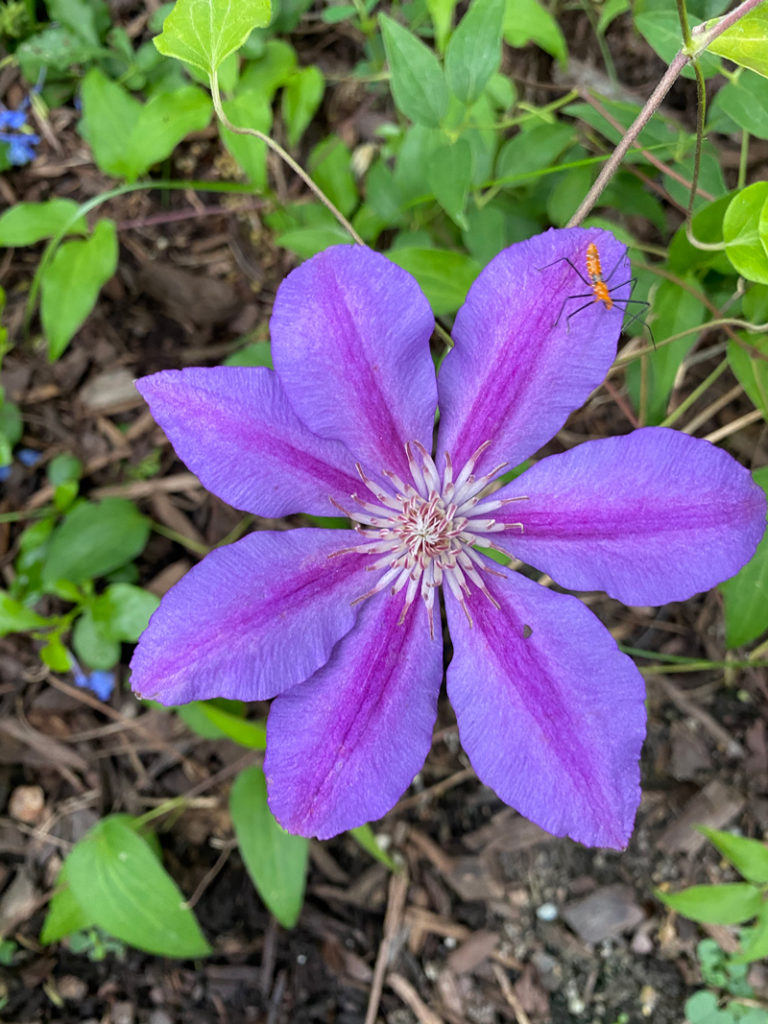
And what are we to make of the bitter ginger flower (also known as shampoo ginger)?
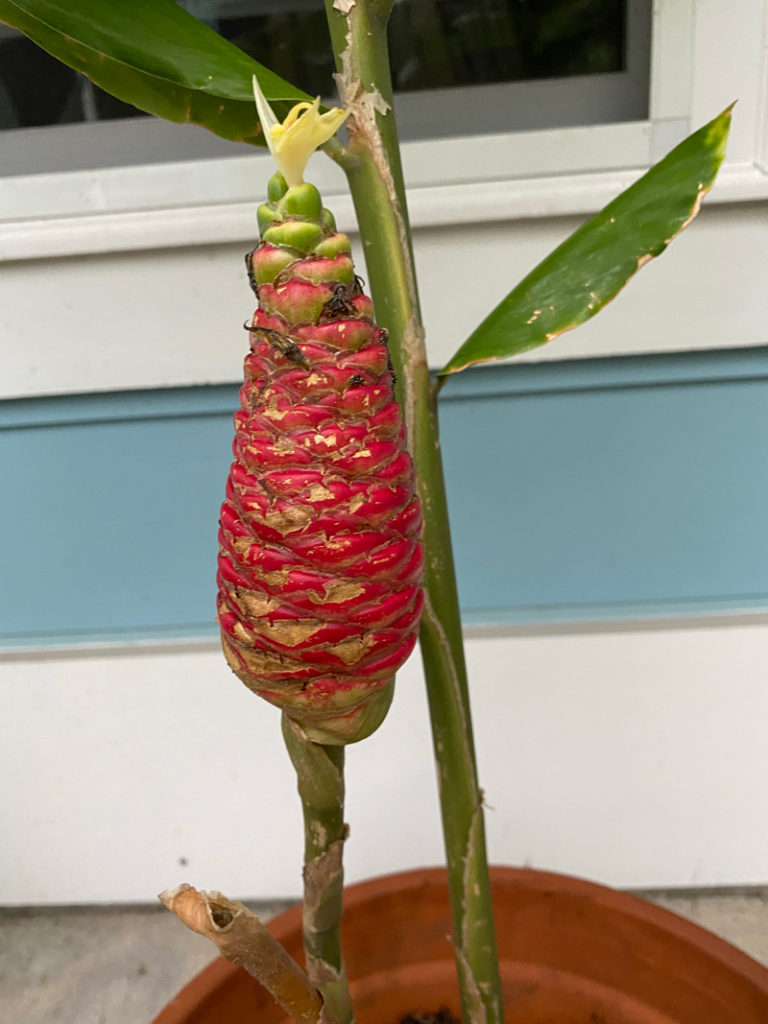
Today I will harvest the flower, and wash my hair with its juices. I love the cone shape of the flower and even the rough edges where some of the petals have fallen off. How to evoke ginger in a poem or piece of art?
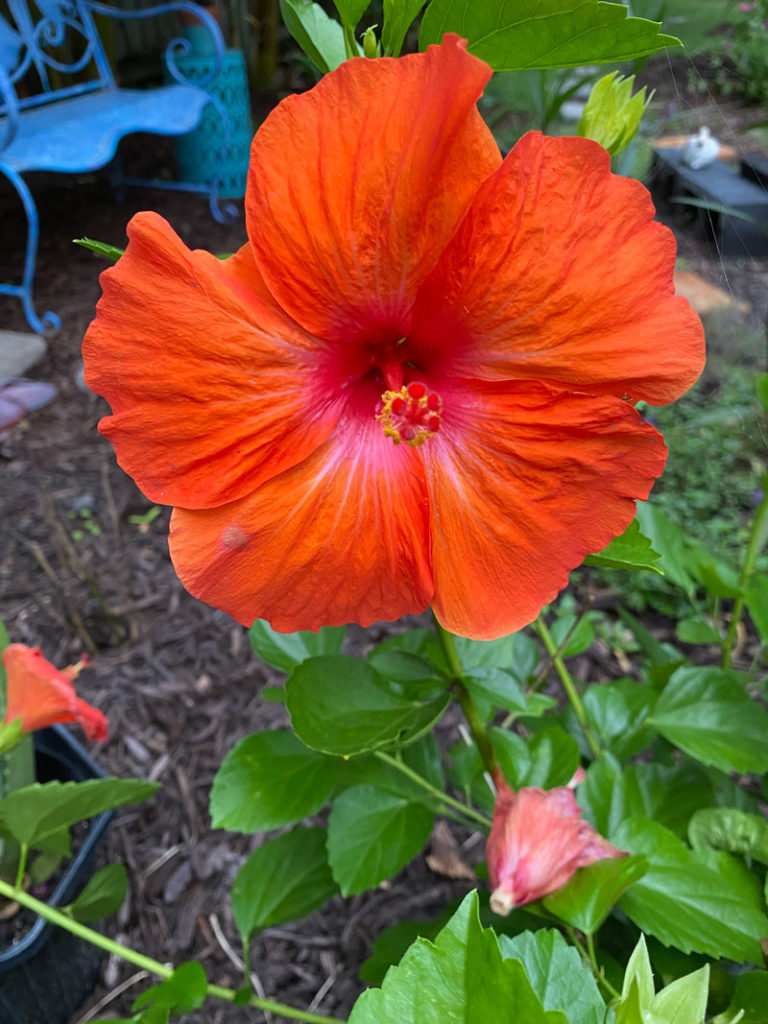
I have several shades of hibiscus in my yard that never fail to bring me joy, though the flowers only last a day.
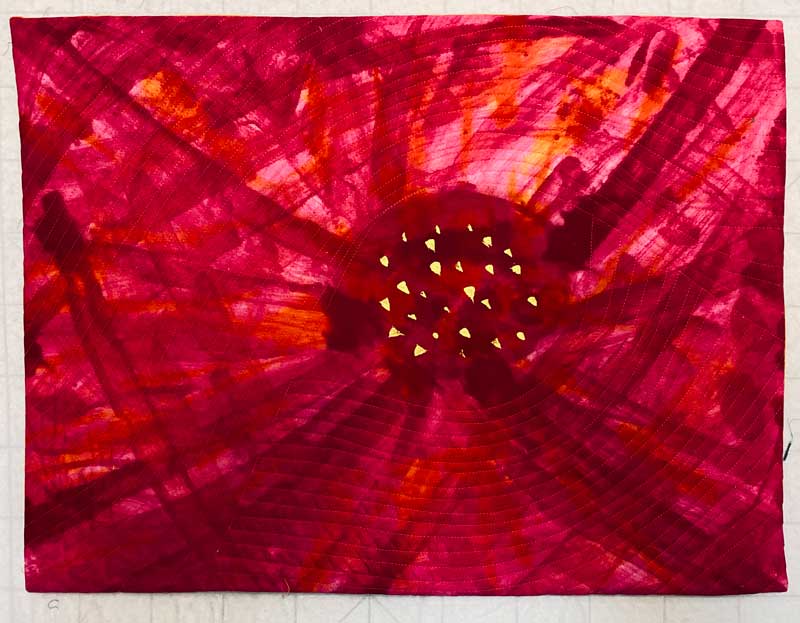
I did make a small art quilt inspired by a hibiscus a few years ago:
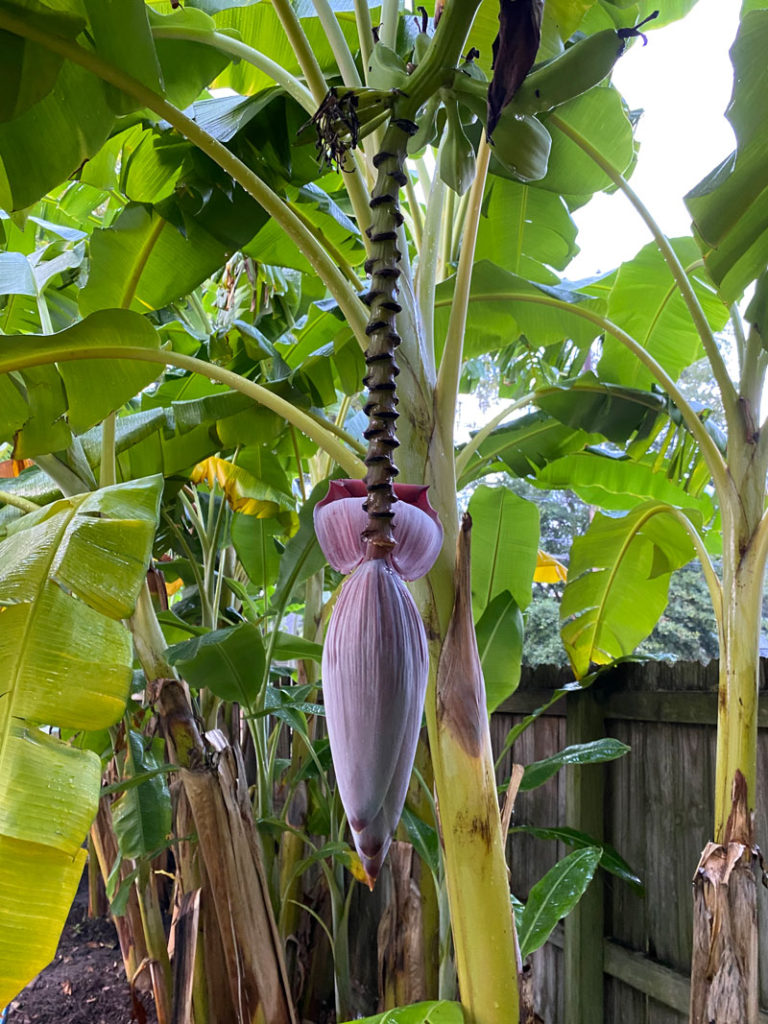
Still thinking about how to respond to this sexy banana flower.
This plumbago I planted in honor of my mother, who had a giant one growing in front of her house as long as I can remember:
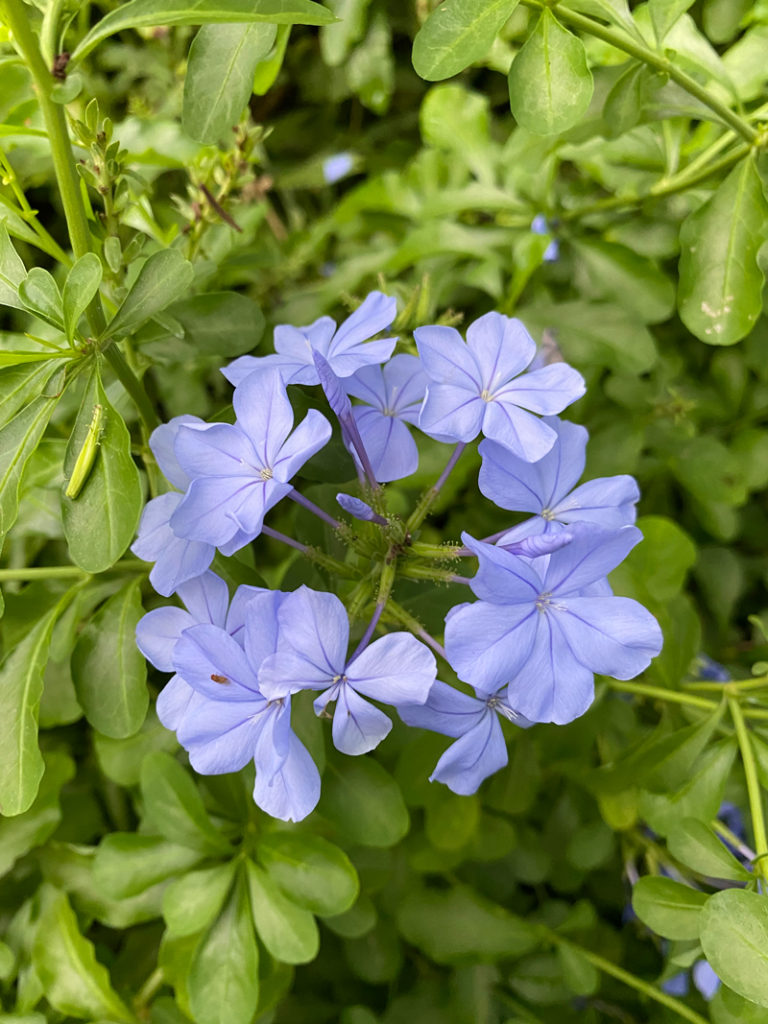
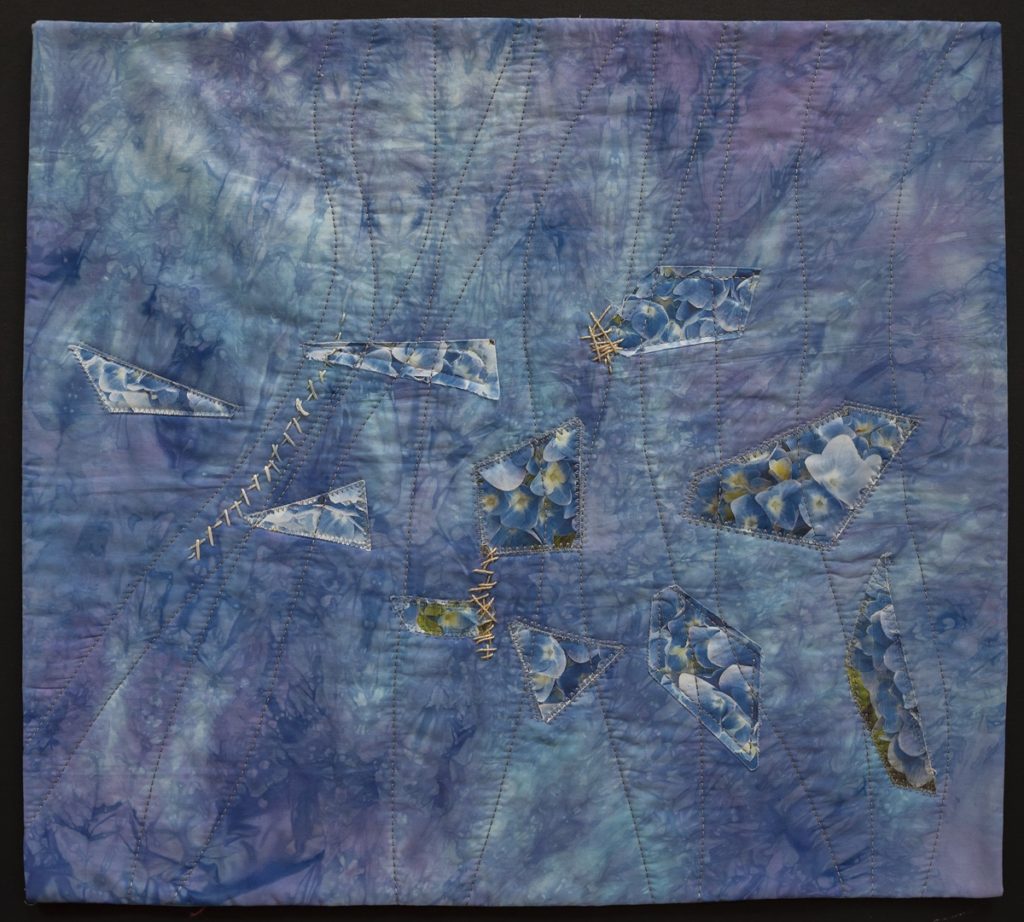
The color is similar to the washed blue/lavender color of the hydrangea she also grew and which I am struggling to grow. She wrote in her journals how she loved Rilke’s poem inspired by the hydrangea.
Blue Hydrangea
Just as the remnant green in tinted pot
So are these leaves, now rough and wrecked
Behind the flower umbels, that reflect
Only a hue of blue, more do they not.
Reflected are they, tear-stained, imperfect,
As if this they were prone to cease,
And as in blue and aged paper leaves
There´s yellow within, grey and violet.
Faded like a washed-out pinafore
No longer worn and of so little use:
How do we our too-short life endure.
But suddenly a blue renewed is seen
Among one of the umbels, and I sense
A blue delighted, smiling at the green.
Rainer Maria Rilke, Tr. Jack Lohrmann
I made a quilt in honor of the hydrangea my mother loved and that I struggled to grow a few years before she died, thinking about how her dementia might have fractured her seeing of it.
you choose the vein
in the back of a hand
to carry
this last intimacy
a puncture mark
the small door
of your death
I imagine, here, that small mark in his vein, as a kind of door to his death. I have thought a lot about this image and wanted to render it in cloth. I’ve made some thirty or so pieces that contained the door as a symbol, but none of them felt right. They were somehow too busy, too elaborate, too forced. I have cut up or discarded these pieces, so I can’t show them to you here.
But a few months ago, in a class with Claire Benn on working with earth minerals, I painted a piece of canvas with black ochre. I meant for it to serve as a background to another piece, so the edges were darker than the center:
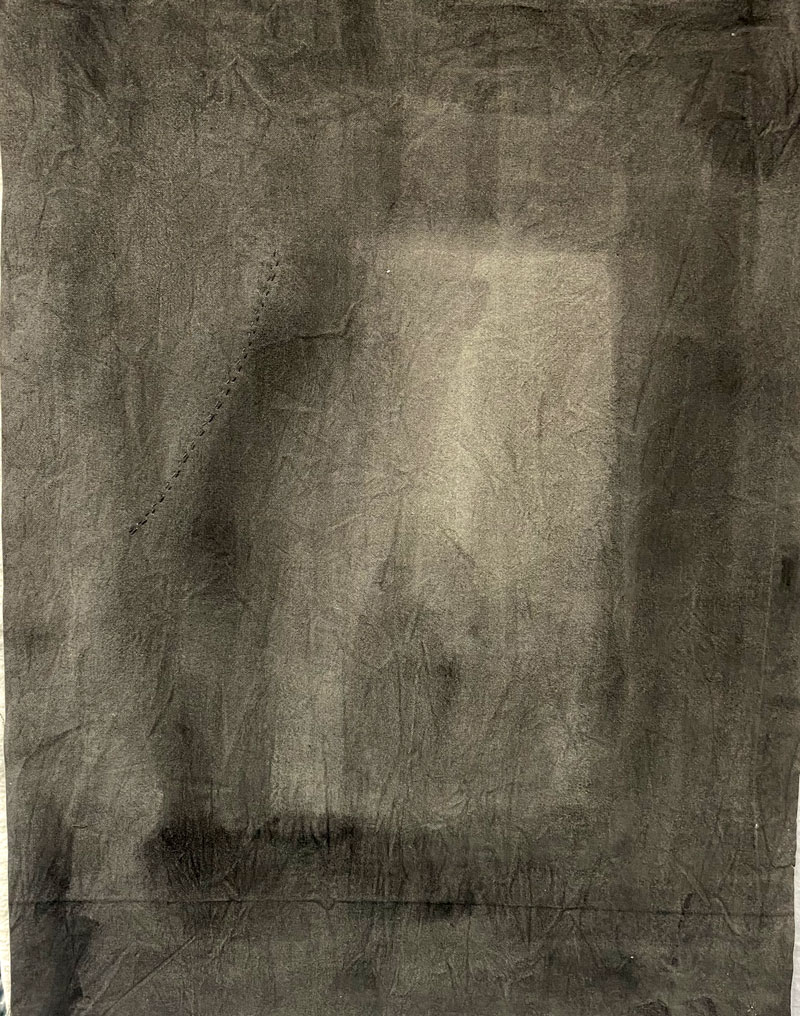
But with the help of others in the workshop, I saw that there was something happening in the cloth that I hadn’t intended. There was the suggestion of a door. I decided this piece might work on its own with only minimal stitching. Here it is with one line of hand-stitching. Today I quilt it with black thread that mimics some of the lines–like veins–that are the result of wrinkles in the fabric. Then I’ll iron it and see where we are.
]]>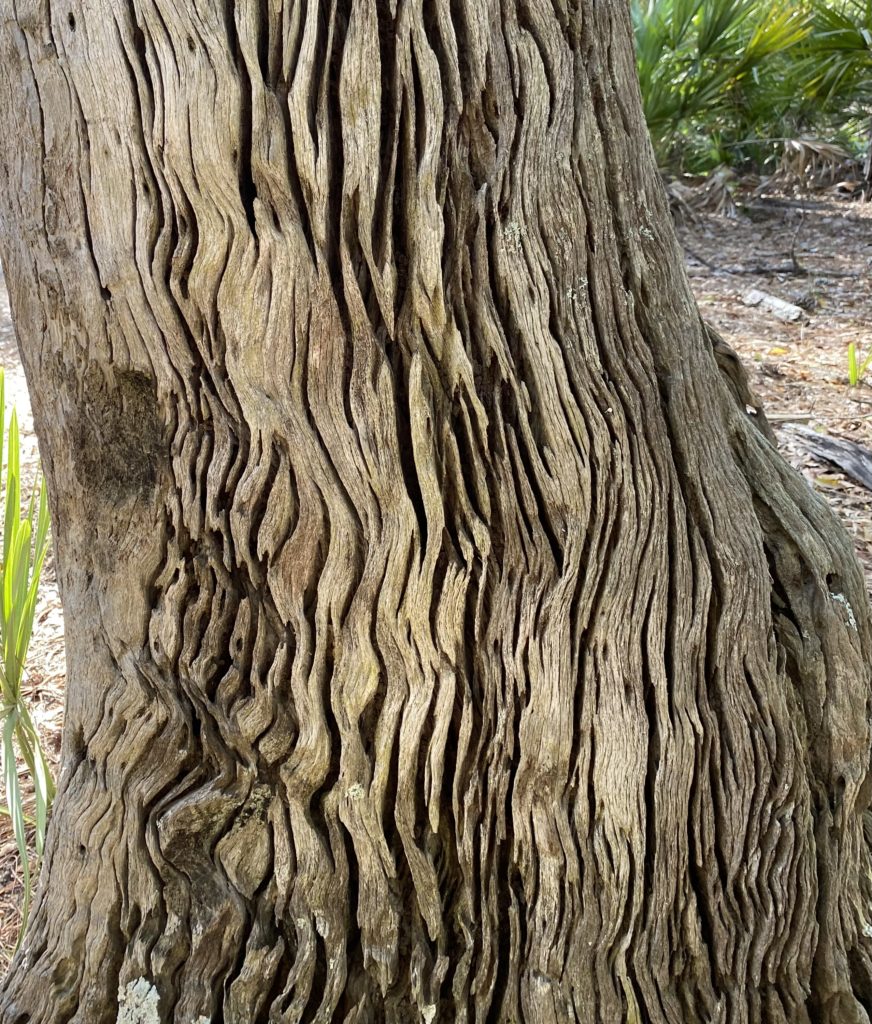
I’m not sure where I took this photo, most likely somewhere in Georgia, maybe Ossabaw Island, but look at the way the cracks in this tree trunk are so beautifully and deeply etched into it. No straight lines here but organic, rippling waves of lines that I’d love to echo in cloth.
Some bark has distinct blocks that remind me of pieced quilts. Some are squarish, like this one:
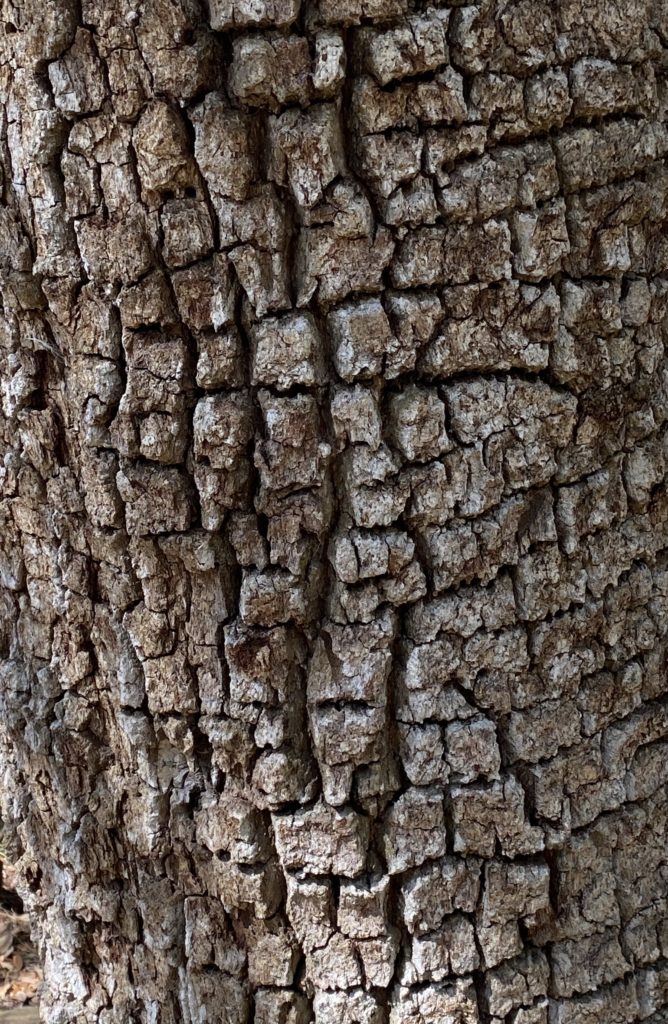
And others are more rectangular, like this one:
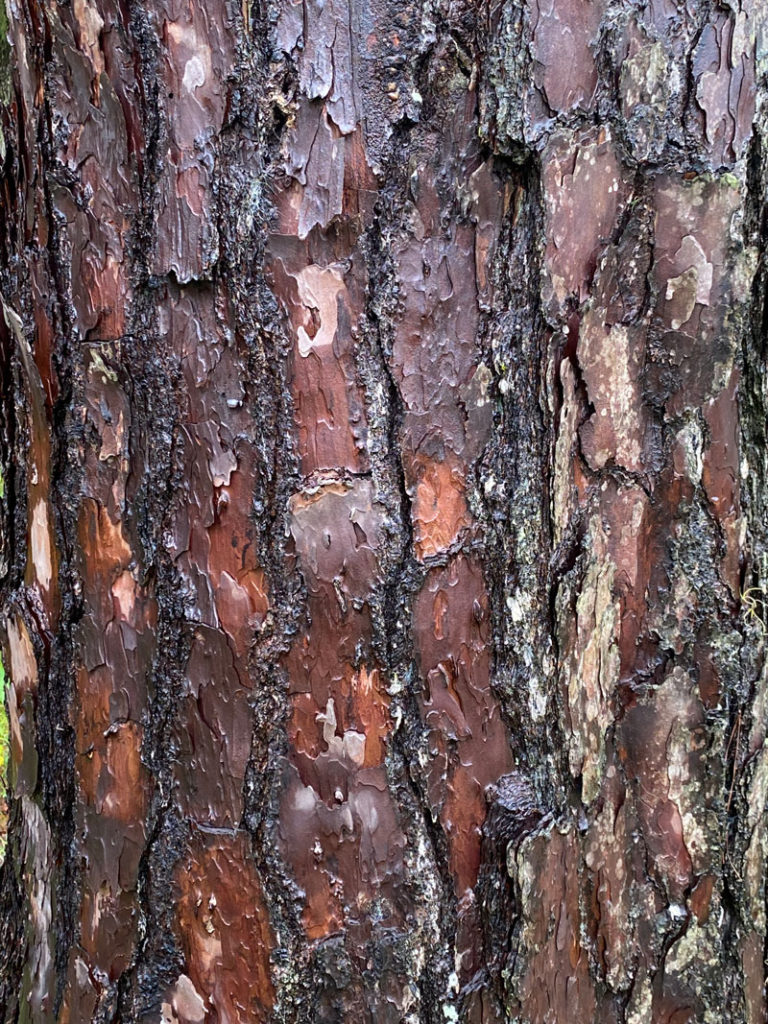
I love the way the barks of trees are built so powerfully–they both protect the tree and offer wonderfully wonky lines for us to admire.
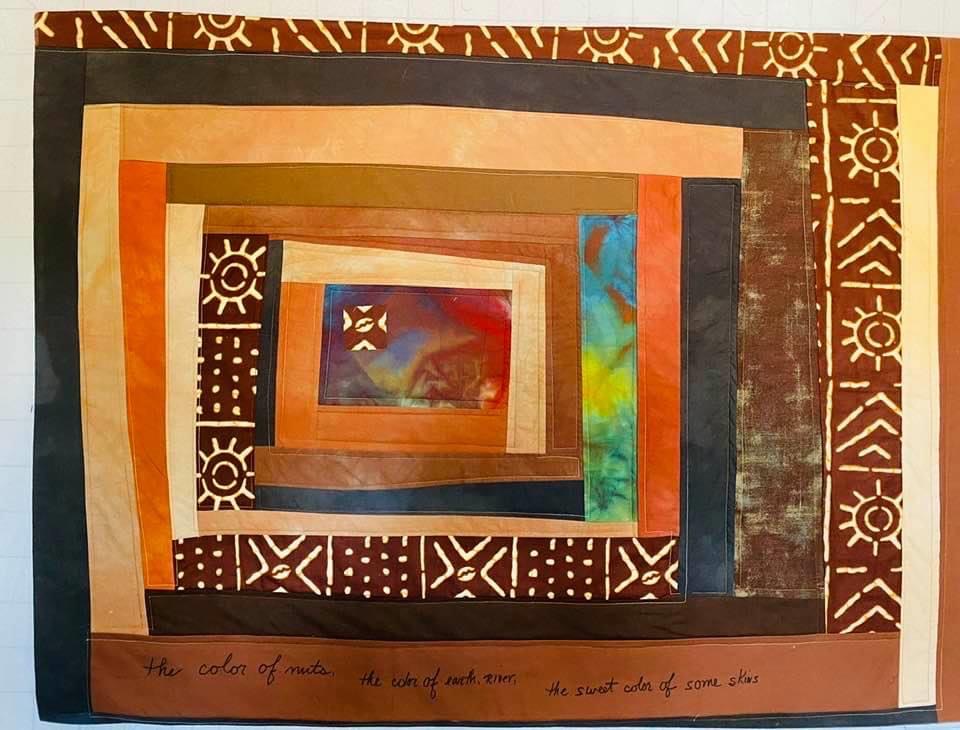
]]>
Traditionally we understand ekphrasis as a written response, often a poem, to a work of art. John Keats’ “Ode on Grecian Urn” is a famous example. The idea, initially, was to offer a visual description for something that could not be experienced by the reader. But often, in contemporary writing, the ekphrastic poem offers less of a description than a response, or the beginning of a conversation with the art. As the development of photography changed the necessity for artists to slavishly depict an object, so too has the ability to share images widely in the digital age lessened the necessity to make poems that attempt to reproduce the art work.
I own a piece of art by my friend, artist Janet Morgan, called “The God Of Questions”:
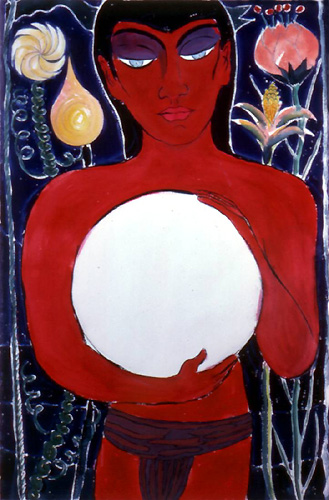
I wrote several drafts of a poem in response to this work, but this prose poem is the one I like best:
Thinking about the God of Questions on Winter Solstice
–for Janet Morgan
He’s the subject of a huge painting given to me by a friend, and he shines above the fireplace mantel, the warm heart of my house. I love most the large white ball he holds in front of him, the ball that hides his nakedness. The ball is almost as large as his torso, and I cannot tell if the white of the ball is painted or bare canvas, whether it is a moon, a sun, or a full round nothingness, pregnant with all that we do not know, but would ask.
Sometimes I think I see destruction in the ball he holds. Other times, especially this darkest of nights, there is a questioning stillness there, and a calmness I’ve seldom known. And in that calmness, hope. As I continue to look, I see it is me the god holds, three years sober, turning my questioning face to the familiar dark.
~
You can see that there are, of course, references to the actual image that she painted, but I’ve allowed my imagination to range widely, imagining that I can see my recently sober, hopeful self in the “ball of questions” the figure is holding. I like best these kinds of “ekphrastic” poems, where art and writing are in conversation, and one is not trying to reproduce the other in a different genre.
I’m also really interested in what it would mean to create a kind of visual art in response to writing, and Janet and I have collaborated on two such books, in both of which I asked her to create something in response to writing. She created the art for my first chapbook, The Mask of Medusa, now out of print (although available used on Amazon for the ungodly price of $88.95!!!!)
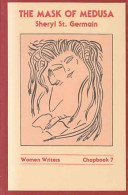
Janet and I also collaborated, recently, on another book, Metamorphoses, a collection of surrealistic prose poems focused on nature and women
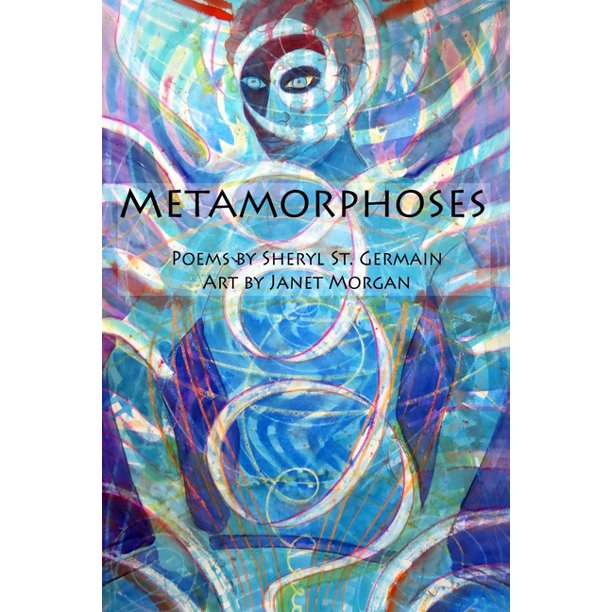
This was also a case where Janet created the art in response to the poems. As I wrote in the introduction, in some cases I sent only one word to Janet, and I worked the poem from the drawing she sent. Sometimes I sent more—an idea for a poem, sometimes a rough draft, less often a finished poem. Sometimes she sent me a drawing that connected with no poem I had yet written, but was somehow in the spirit of what we were doing, and I wrote a companion poem. The goal was not to redo in words or in drawings, what the other had done, not to become the other, but to be connected with the other in some deep way, to be in conversation with the other. The drawings in this book are not intended as illustrations of the poem, nor are the poems intended to explain the drawings. Although there are connections between the two—maybe an image, or a kind of starkness or richness, or a feeling; the two are, rather, companions, translations, indeed, one might even call them metamorphoses of each other.
My friend Darrell Bourque has also long worked with ekphrastic poetry, and what one might call ekphrastic art. He has collaborated with the abstract expressionist Bill Gringles on several books, the most recent of which is migraré:
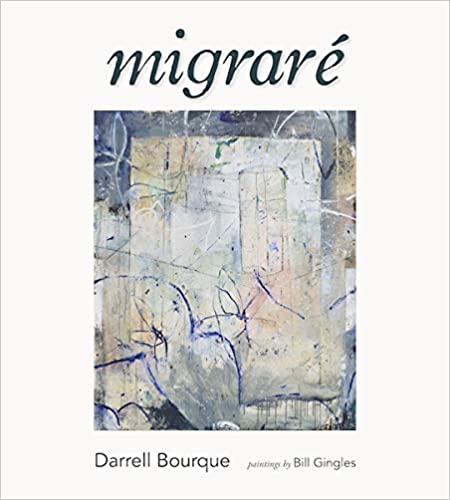
Etruscan Press is going to publish Darrell’s new book, Until We Talk, later this year or next, which is another collaboration with Gingles. The book is a masterpiece of ghazals and art. The poems are ekphrastic in the sense that they are responding to another work of art–but not visual. They are written in response to Colum McCann’s novel Apeirogon. What shines through in the poems is Bourque’s care for the voiceless, and his desire to be inside those whose voices he wants to understand and amplify. The generosity of his spirit is manifest in every poem, even in the very structure of the manuscript and its honoring of another writer’s work. I think the choice of the ghazal is appropriate in so many ways, the couplets that twin his voice and Colum’s.
So a book in conversation with a book. But also of great interest to me is how Gingles paired paintings that were already completed with the poems Bourque wrote. Gingles writes in the introduction,
“Since the paintings and poems were not originally keyed to each other, the challenge was to find a way to pair them in real and meaningful ways. I knew my paintings intimately but the poems, as they trickled in through the weeks, were new to me. I realized that some degree of intimacy with the poems would be necessary in order to find a way to make each pairing. This would mean living with the poems. Reading them again and again. Reading them with images of paintings in an adjacent window on my computer screen or on my studio wall nearby. Seeing the poems play out in my mind. Feeling myself a witness to the social crimes and injustices, the tragedies, and the poignant beauty that sometimes came from them.”
Gingles writes that he made himself open to any part of the poem; it could have been the title, an epigraph or phrase, a narrative element or even a color that was referenced. I’m looking forward to the publication of this book so I can share more with you about this sort of “reverse” ekphrasis.
In the next post I’ll talk about how I chose a Gingles image for the cover of my last book, 50 Miles and how that led to my thinking about making fiber art in response to poetry and essays I’ve written.
]]>